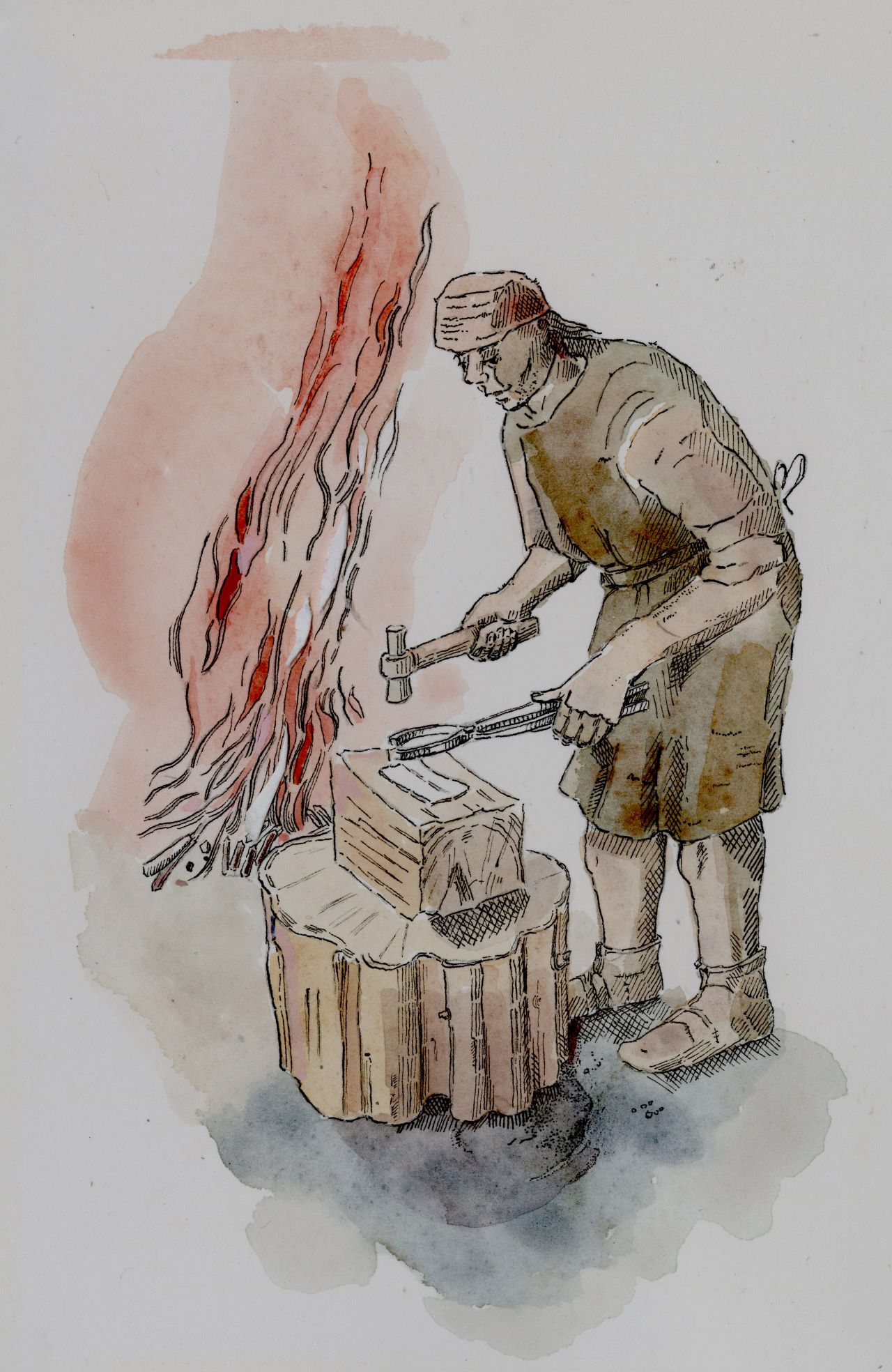
 A blacksmith crafting tools.
As you stand near the earthworks, imagine the forges blazing and hammers shaping iron a technological leap that helped forge the future.
The Double Dykes
Around 2,800 to 2,600 years ago, a thriving settlement emerged at Hengistbury Head. In the following centuries, the ancient inhabitants of Hengistbury Head dug a huge earth double bank and ditch that we call the Double Dykes.
Although flattened by time, this vast earthwork can still be seen today.
It formed an inner wall of a rapidly growing settlement that spread from outside of Double Dykes, across the inner shore of Hengistbury Head.
Forges and Furnaces
The people from within this settlement were resourceful and innovative and started to practice the smelting and forging of iron, a new metal that gives this period its namesake. Iron could be harder than copper or bronze and could be hammered or "forged" into different shapes to make tools and weapons.
The process of smelting iron involved heating the iron-rich rocks, especially the abundant doggers at Hengistbury Head, inside blazing furnaces made from clay and fired with charcoal.
These furnaces, the remains of seven of which were found on the top of the cliffs at Hengistbury Head, needed to reach temperatures over 1000°C, similar to molten lava. The resulting metal could be headed and hammered at lower temperatures, over 500°C.
Iron Age homes
In the Iron Age, people at Hengistbury Head lived in round thatched dwellings that we call roundhouses. These likely came in a wide variety of shapes, sizes and materials. Iron Age builders would have considered what nearby resources they had to hand when considering what sort of roundhouse to make.
At Hengistbury Head, river reed grows in abundance in the harbour and estuary and heather on the heathland, providing a ready source of thatching material that could be used to make waterproof roofs. Hazel, Hawthorne and Elder grew on the headland, giving different types of wood for weaving wattled walls or raising rafters. Wattled walls made in this way were likely covered in daub, a sticky, hard-setting mixture of clay, animal dung and straw that could be packed onto the frame of the walls to seal out draughts and insulate the house in winter.
Good clay is abundant on Hengistbury Head and would be easily obtainable from digging pits or as a by-product from digging ditches or other excavations needed in a growing settlement. Rope for binding timbers can be made from heather, bast fibre or nettles but would have been time-consuming to make, so it would have been used sparingly.
We don't have any surviving roundhouses from Hengistbury's head in the Iron Age due to the organic materials used in their construction, which will decompose over time. However, careful excavation in the 1980s uncovered the holes left behind by the posts used in their construction and ditches that Iron Age people dug to funnel rainwater away from their houses. The diameter of these ditches and post holes allows us to say how large the houses were and then propose an interpretation of what they may have looked like and how they may have been made using the tools available in the Iron Age.
In exceptional examples from Hengistbury Head, some houses were built using walls made from oak planks rather than wattle and daub, potentially indicating that many of the Iron Age inhabitants of Hengistbury Head were wealthy or of high status. Using oak planks in house construction could be a marker of higher social status within the community due to the increased labour involved in crafting planks.
As you explore, picture these homes bustling with life, each telling its own story.
How to get here
The postcode of this site is: BH6 4EW
Or you can use What3Words: ///drew.bench.blast
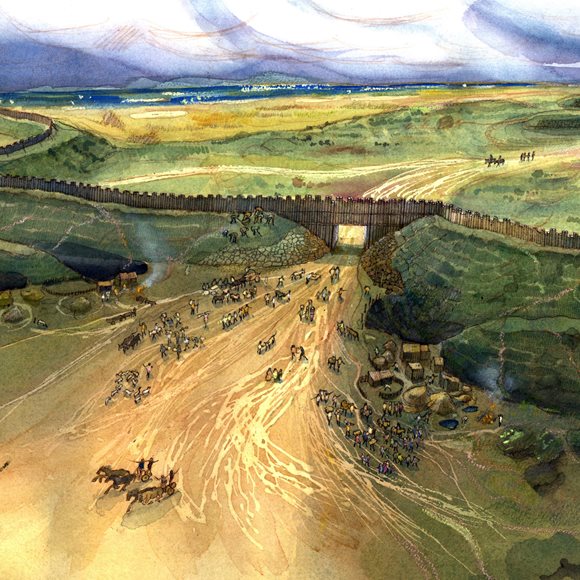 The Double Dykes at Hengistbury Head.
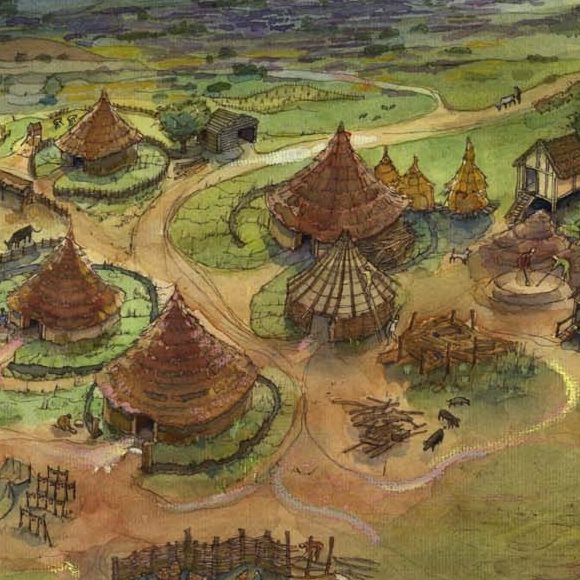 Iron Age houses at Hengistbury Head.